Short story. Good at Saying Goodbye.

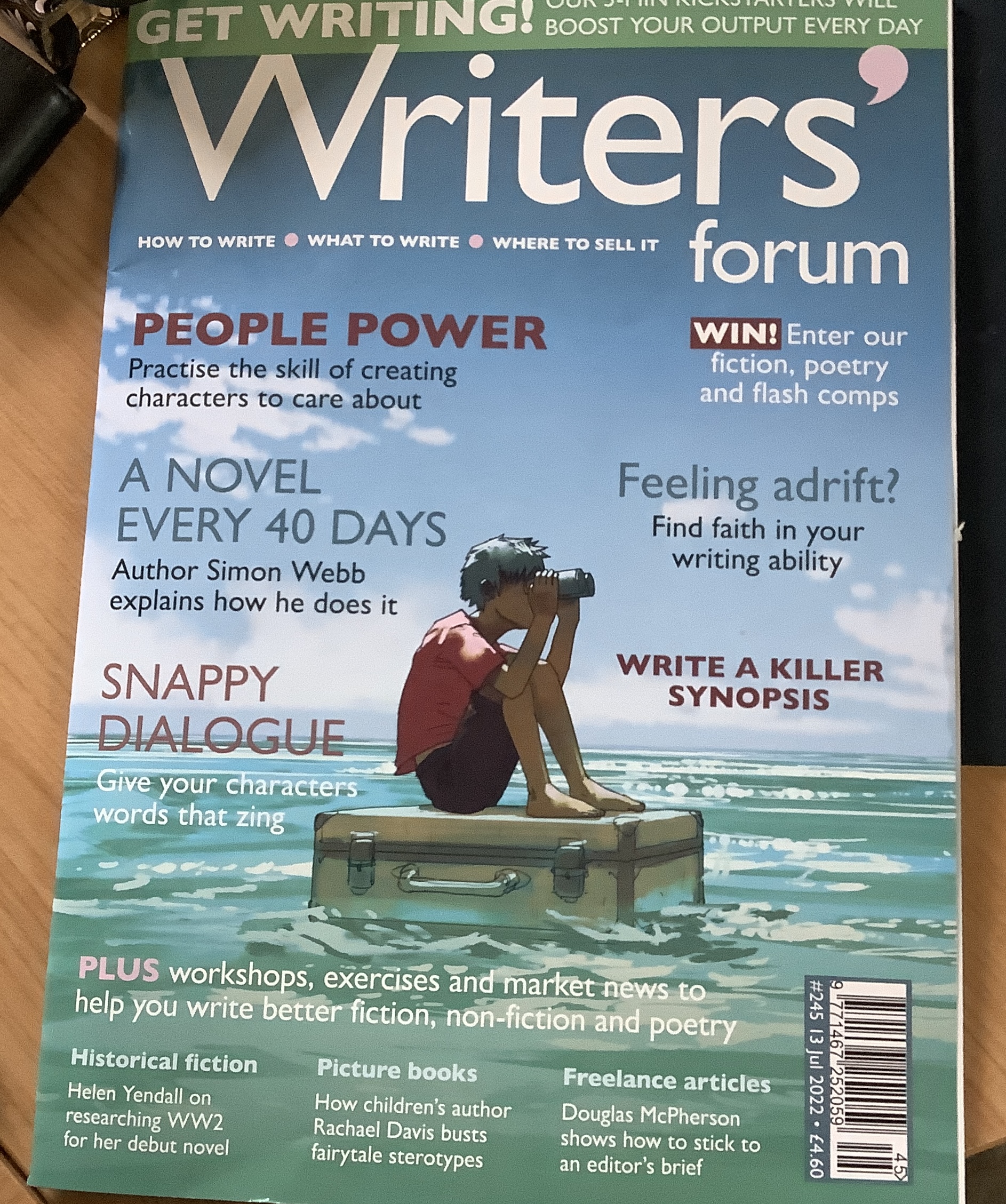
In the current issue of Writers’ Forum, I am writing about how I got the idea for one of my short stories and promised that the story in question, Good at Saying Goodbye, would be on my blog.

So, here it is.  And if you have taken the trouble to come here after reading my Idea Store column, then thank you very much.

If not, then I hope you too will enjoy the short story, which came about after I got chatting to a lady in a supermarket car park. 

Good at Saying Goodbye

Continue reading “Short story. Good at Saying Goodbye.”

A reader’s special memories – and my short story OUT OF BALANCE

It’s always a delight to hear from readers and recently a lovely lady called Gilly Metcalfe wrote to me to say how much she enjoyed my Idea Store column in Writers’ Forum, particularly the one where I was talking about how my family have inspired so many of my short stories.

“I have so many handed down family stories ” she told me. “My mother was one of ten children and like you, loved putting on plays.  My grandfather, a publican, was a founder member of Chelsea football Club and had the Rising Sun ( now The Butcher’s Hook)  they were just opposite the playing field at Stamford Bridge and my aunts and uncles had many childish memories of hilarious events connected with those days.

Continue reading “A reader’s special memories – and my short story OUT OF BALANCE”

Where does JD Kirk get his ideas from?

I am delighted to welcome one of my favourite authors to my blog this week.

I discovered crime writer JD Kirk thanks to the great Facebook group that I’m always mentioning – The UK Crime Book Club.  I joined a few years ago now when the numbers were in the low hundreds and there are now, I believe, over 20,000. I have met some fabulous, new to me writers there – and JD Kirk is way up there with the best of them. (Sorry if I sound a bit fan-girly but I had Covid recently and JD’s Logan series as well as his new series, took me right out of myself and even made me laugh out loud on days when I really didn’t feel like laughing).

So if you haven’t come across his books yet, do check them out. The DCI Logan books are police procedurals set in Scotland.  They are full of brilliantly drawn characters, evocative settings and great storylines. He is (as I’ve said in the magazine extract below) one of those truly gifted writers who can make you laugh and cry in the same scene.  There is one scene in particular that for some reason has stayed in my mind all this time, where he’s delivering some harrowing news to a couple and it’s all very emotional and sad.  But at the same time he is sitting in one of those bendy Ikea chairs and wondering how on earth he is going to get out of it!  I have one of those chairs and the memory of that scene makes me laugh every time I sit in it. 

Continue reading “Where does JD Kirk get his ideas from?”

Where does romantic suspense author Morton S Gray get her ideas from?

I’m delighted to welcome romantic suspense author, Morton S Gray to my blog this week.

I featured her recently in my Ideas Store column in Writers’ Forum because I had recently read and enjoyed The Truth Lies Buried with its engaging characters, lovely setting and a great storyline.  I was intrigued to find out where the idea for the book came from.  So I invited her on to my blog and thankfully, she said yes.

Me

Welcome, Morton and thank you for agreeing to answer my questions, particularly the one all writers are said to dread.  (Although I love it when people ask me that question!)

Where do you get your ideas from?

Morton

I have no problem finding ideas for books, it is more the time to write up all of them I struggle with.

At a writing workshop run by author Linda Gillard at a Romantic Novelists’ Association conference, Linda handed out postcards to evoke a descriptive piece of writing. My postcard was an advertising postcard for a company producing quirky garden buildings, the one in the picture was a fairy-tale castle complete with pointed turret towers and arched windows. I dutifully completed the descriptive writing and then, after the course, started to ponder who would live in a house like that and Carver Rodgers, carpenter and hero of The Truth Lies Buried was born.

For me inspiration can come from anywhere. The hero of my first published novel, The Girl on the Beach was conjured from a model’s face in a clothing catalogue. The first scenes at a high school art competition were from an art exhibition at my son’s school. I have been known to furiously scribble down bits of overhead conversation in cafés and have an overflowing file containing pictures of potential characters, rooms and locations.

Ideas and themes come to me at inopportune moments, like when I’m driving or taking a shower. I do try to keep a notebook to hand, particularly in the bathroom, but have been known to have opened out empty cardboard toilet roll tubes with closely scribbled writing on them in my ideas pile. I love writing first drafts long hand when I have the luxury of time and have been known to write at my son’s swimming lessons, sitting in doctor’s waiting rooms, on trains, planes and buses. I even tried to capture my feelings of trepidation when I was waiting to be taken down to the operating theatre one time.

My fictional seaside town of Borteen, which has been the location for six published novels so far, is very real to me. I can walk along its streets in my head and have drawn a map on several pieced together sheets of paper with the key locations marked and images stuck to the map depicting how I see the buildings, beach and caves.

It sometimes feels like I am an empty container and ideas like to find their way to me to fill this up when I least expect it. The process of piecing diverse ideas together for characters and scenes almost like a patchwork quilt is for me the most exciting part of writing a novel.

Me.

That’s brilliant.  I love the sound of Borteen which you have brought so vividly to life.  You’ve mentioned you have based six novels there.  Are your books a series? Or can they be read as standalone?

Morton

For the past few years, I have been writing stand-alone novels, but set in my fictional seaside town of Borteen. Inevitably in a small town, some characters from previous novels have a role in a new story, but the books can be read in any order.

Me

And how would you describe your genre?

Morton

My books are usually categorised as Romantic Suspense, but I describe them as romance with a mystery to solve.

Me

So far I have read two of your books (and very much looking forward to reading the others) and have loved the mystery element in both.  What inspires you most?

Morton

My inspiration can come from anywhere. It can be a couple of words in a song or even a phrase overheard in a café. I can see a face in a magazine of clothing catalogue and a character can develop from there. If I let my mind freewheel, a story often appears. I have absolutely no problem finding ideas for novels, it is more the time to write up all of them I struggle with.

Me

How did your writing journey start?

Morton

I truly cannot remember a time when I haven’t written or read avidly. Those were my favourite things at school. I used to hide away and write poems as a child and wrote my first novel aged fourteen. That first one, which I still have, features galleons and pirates. I think it was inspired by the Errol Flynn films I used to watch with my nan on Sunday afternoons.

Inevitably life got in the way and I didn’t take my writing seriously until I was in my fifties when life took yet another turn. I won a short story competition and began to attend a weekly writing class. My first novel was published after I won Choc Lit Publishing’s Search for a Star competition in 2016 with the manuscript that became The Girl on the Beach. I guess I am the proof that it’s never too late.

Me

Indeed it’s not.  I’m looking forward to seeing those pirates and galleons make an appearance in a future Borteen novel. (Now there’s a challenge for you!)

Finally, tell us three things we might not know about you.

Morton

  1. My favourite period of history is The English Civil War – I have more books in my study about this period of history than anything else.
  2. I’m an avid family historian and have been for many years, even teaching the subject at night school at one point.
  3. I make my own soap. I’ve been on a mission to reduce the amount of plastic in my bathroom and as a part of that I went on a course to learn to make and perfume my own soap and I now use solid shampoo bars.

Me.

Thank you so much for answering my questions so patiently – and I too have discovered the joy of using solid shampoo bars. (I don’t make my own though, but maybe one day…)

Author Bio

About Morton S. Gray

Morton lives with her husband, two sons and Lily, the tiny white dog, in Worcestershire, U.K. She has been reading and writing fiction for as long as she can remember, penning her first attempt at a novel aged fourteen. She is a member of the Romantic Novelists’ Association and The Society of Authors.

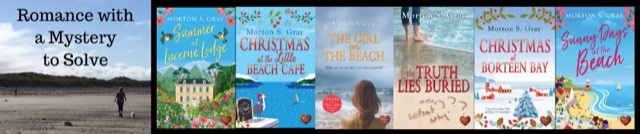
Her debut novel The Girl on the Beach was published after she won the Choc Lit Publishing’s Search for a Star competition in 2016. Her other books for Choc Lit are The Truth Lies Buried, Christmas at Borteen Bay, Sunny Days at the Beach, Christmas at the Little Beach Café and Summer at Lucerne Lodge.

Morton previously worked in the electricity industry in committee services, staff development and training. She has a Business Studies degree and is a qualified Clinical Hypnotherapist and Reiki Master. She also has diplomas in Tuina acupressure massage and energy field therapy. She enjoys crafts, history and loves tracing family trees. Having a hunger for learning new things is a bonus for the research behind her books.

You can catch up with Morton with the following links:-

Website and blog at www.mortonsgray.com

Twitter @MortonSGray

Author – https://www.facebook.com/mortonsgray/

Instagram – htwww.instagram.com/morton_s_gray/

Morton is celebrating two things at the moment, the release of her sixth novel for Choc Lit – Summer at Lucerne Lodge and the paperback release of Sunny Days at the Beach.

Summer at Lucerne Lodge tells the story of Tanner and Rosie. They first meet at a charity auction held in the grounds of Lucerne Lodge on the outskirts of the seaside town of Borteen. However, that first meeting isn’t as innocent as it sounds, because Tanner has found a private investigator’s file on his father’s desk about Rosie and wants to know why …

Sunny Days at the Beach begins when commitment free singleton and craft shop owner Mandy takes in an abandoned teenager, but then gin distillery owner Graham arrives in Borteen with some unexpected news 

Buying links for Summer at Lucerne Lodge

Amazon http://getbook.at/SummeratLucerneLodge

Choc Lit for other retailers https://www.choc-lit.com/dd-product/summer-at-lucerne-lodge/

Buying links for Sunny Days at the Beach

Amazon http://getbook.at/PaperbackSunnyDays

Choc Lit for other retailers https://www.choc-lit.com/dd-product/sunny-days-at-the-beach/

Where does Nathan Dylan Goodwin, author of the Forensic Genealogist series, get his ideas?

I am delighted to welcome to my blog this week Nathan Dylan Goodwin, author of the Forensic Genealogist series of mysteries.

I am not very keen on television programmes that feature ‘celebrities’ but the one I make an exception for is Who Do You Think You Are? where a series of experts help celebrities to trace their family trees and discover their ancestors. (Although I think the programme would work equally as well, if not better, with non-celebrities).

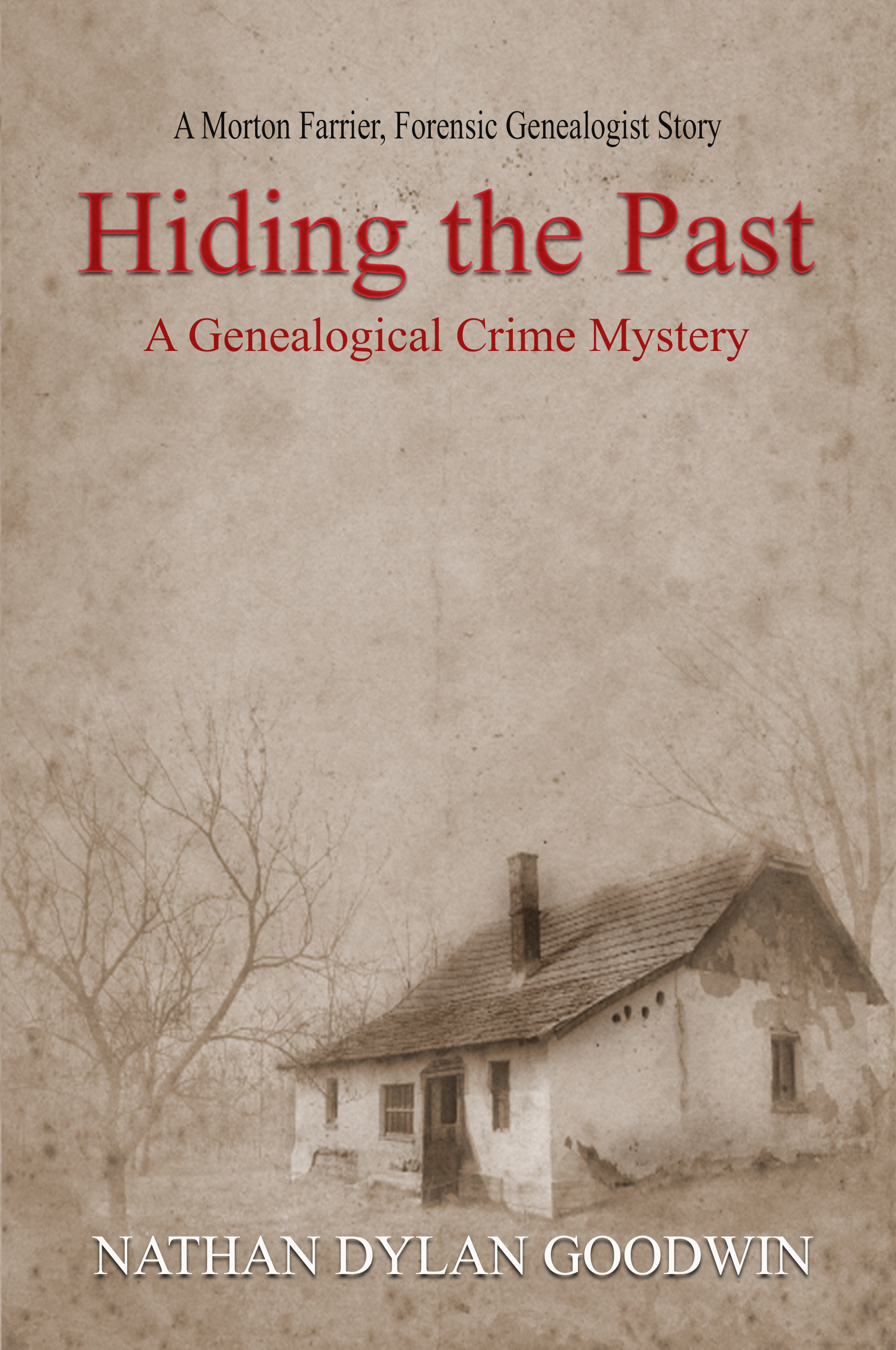
So I was intrigued and delighted when I came across Nathan’s book, Hiding the Past, which had the words ‘A Morton Farrier Forensic Genealogist story’ above the title.  What, I wondered, was a Forensic Genealogist?  So I read the book to find out.

There are currently eight books in the series and I have stormed through every single one, one straight after the other.  I just couldn’t stop reading them!  And it was not helped by the fact that at the end of each book there was the opening chapters of the next one!  

I loved the mixture of history, mystery and the gradual unravelling of Morton’s own less than straightforward family history so I got in touch with him and asked if he would agree to do an interview for my column in Writers’ Forum and for this blog.

Me.

Welcome to my blog, Nathan, and, first of all, thank you for the many hours of reading pleasure you having given me through your Morton Farrier series. I have just finished the eighth in the series, The Sterling Affair, and am eagerly looking forward to the next one. So, how did you come up with the idea in the first place?

Nathan

Whilst undertaking an MA in Creative Writing at Canterbury Christ Church University, I began writing a story featuring a genealogist who tries to solve a crime in the past using genealogy, a kind of ‘Who Do you Think You Are?’ spin on the traditional detective genre. 

The story eventually became Hiding the Past, the first book in what has turned into an ongoing series with Morton Farrier as the main protagonist. Each book is partly set in the modern day and partly set during a different period in history where the crime has occurred. Morton is himself adopted and, whilst trying to solve the crimes (often getting himself into precarious situations during the course of his investigations), strives to discover the identity of his biological parents.

Me.

It’s a great idea and I have really enjoyed following Morton’s journey.  How would you describe the genre in which you write?

Nathan

My books sit within the growing niche genre of genealogical crime mysteries, a hybrid of crime, mystery and, oftentimes, historical fiction. When I started writing, there were very few books within this genre, but it is wonderful to see it flourishing with a variety of fantastic authors. It was only during the latter stages of writing the first book, Hiding the Past, that I realised that it had the potential to become a series. It was so well received that I decided to carry on. I’m still going!

Me.

I’m delighted to hear it.  Your most recent book is The Sterling Affair.  I really enjoyed all the twists and turns in this one.   

Nathan

The Sterling Affair – The Blurb.

When an unannounced stranger comes calling at Morton Farrier’s front door, he finds himself faced with the most intriguing and confounding case of his career to-date as a forensic genealogist. He agrees to accept the contract to identify a man who had been secretly living under the name of his new client’s long-deceased brother. Morton must use his range of resources and research skills to help him deconstruct this mysterious man’s life, ultimately leading him back into the murky world of 1950s international affairs of state. Meanwhile, Morton is faced with his own alarmingly close DNA match which itself comes with far-reaching implications for the Farriers.

Me.

I enjoy reading the notes at the end of each book where you detail the research that went into each one.  What inspires you most when you’re deciding what to write?  Is it characters?  Settings?  A particular moment in history?

Nathan

I’m most inspired by the nugget of a story—usually with factual elements—that I think I can weave into a fiction story. I just love the moment when the idea takes on a life of its own. For example, with my last book, The Sterling Affair, that moment occurred when I received an email from The National Archives announcing the release of new, previously classified MI5 and MI6 records. Having taken a cursory view online, and then a much more in-depth look at the actual documents held by TNA at their repository in Kew, London, I began to work on a story about a spy network operating in the 1950s. Ideas for characters and settings then begin to form and take shape out of such research that I undertake.

Me.

That’s fascinating.  And how did you writing journey start?

Nathan

I’ve always loved writing but never thought that it was something that I could do as a career, until I had my first non-fiction book, Hastings at War, published. It was followed up with three further local history books, which led me to want to explore fiction writing in the form of an MA in Creative Writing. 

It was during this course that I first came up with the idea for the Forensic Genealogist series, featuring Morton Farrier as the eponymous character who has to solve a crime in the past using genealogy. The first book, Hiding the Past, turned into a series and since 2015 I have been a fulltime writer.

Me.

And what about your future plans?  More Forensic Genealogist books, I hope!

Nathan

I have ideas for several more books in the Forensic Genealogist series, plus others for another series that I have started with The Chester Creek Murders, which was released in January 2021 and is about the use of investigative genetic genealogy to solve cold cases in the U.S. My notes file for future writing projects is huge.

Me.

Great. That sounds fascinating. I look forward to that.  Finally, tell us three things that we may not know about you.

Nathan

1. Long before commercial testing was available, I was DNA tested by the U.S Armed Forces DNA Identification Laboratory in a project they were running to identify the ‘Unknown Child’ who had drowned onboard the Titanic. He was successfully identified as Sidney Leslie Goodwin.

2. I collect bowler hats and eagerly await the day that they come back into fashion so I can actually wear them.

3. Before I became a writer I had a range of glamorous jobs, including working in a chocolate factory eating packaging chocolate buttons, fruit-packing, a gardener’s assistant, fishmonger, delicatessen worker, drama technician and, most recently, a primary school teacher.

Me.

Thank you so much, Nathan, for a fascinating interview – and I look forward to the return of the bowler hat.

Author Bio

Nathan Dylan Goodwin is a writer, genealogist and educator. He was born and raised in Hastings, East Sussex. Schooled in the town, he then completed a Bachelor of Arts degree in Radio, Film and Television Studies, followed by a Master of Arts degree in Creative Writing at Canterbury Christ Church University. A member of the Society of Authors, he has completed a number of local history books about Hastings, as well as several works of fiction, including the acclaimed Forensic Genealogist series. His other interests include theatre, reading, photography, running, skiing, travelling and, of course, genealogy. He is a qualified teacher, member of the Guild of One-Name Studies and the Society of Genealogists, as well as being a member of the Sussex Family History Group, the Norfolk Family History Society and the Kent Family History Society. He lives in Kent with his husband, son, dog and chickens.

Social Media Links, blog, website etc.

Twitter: @NathanDGoodwin

Facebook: www.facebook.com/NathanDylanGoodwin  

Instagram: www.instagram.com/NathanDylanGoodwin 

The all important buy link.  

www.nathandylangoodwin.com 

https://getbook.at/TheSterlingAffair

Where do these talented Criminal Shorts authors get their ideas from? Part 2.

This is the second post featuring some of the authors who contributed to the Criminal Shorts anthology I talked about in my last post. It can be found here.

Towards the end of 2020 I was delighted to be included in this anthology which was collated by one of my favourite Facebook groups and sold in aid of a very special charity.

UK Crime Book Club is a thriving, well run book club on Facebook with a great mix of authors and readers. (As I write this there are 18.7k members, of which over 500 are authors, including big names  and some not-so-big names – like mine.)  

Link here to UKCBC

I asked the 22 authors who are included in the book where they got the idea for their stories from and had so many responses that I’ve had to publish this blog in two parts.

*****

Samantha Brownley (writing as Sam Thomas).

Short story: Six Pieces Each

“When I first started writing a story for Criminal Shorts, I had something completely different in mind that just wasn’t working,” she says. “Wondering what on earth I was going to write, I pulled out my stack of notebooks and found a detailed idea that I had written months before. Six Pieces Each is loosely based on my original plan. It came together over a weekend and changed dramatically as I got to know the main character, Josie. It’s quite a dark story in places, certainly different to what I have written before. It was my first published fiction and seeing it in print alongside so many wonderful authors has been a dream come true.”

Sam lives in Manchester with her husband and three children.  She loves to read crime fiction and  interviews authors for the UK Crime Book Club. She writes blogs for businesses and is a teaching assistant in a Primary School.  Six pieces each is her fourth short story and the first fiction she has ever put forward for publication.

Sam is currently working on her first novel.

*******

T.G. Campbell.  Author of Bow Street Society series.

 Short story: The Case of the Devil’s Dare

“The idea behind the Bow Street Society is to celebrate the ordinary through the extraordinary by showing how the skills and knowledge we acquire through our everyday jobs can help us achieve fantastic things—like solving mysteries,” TG explains. “My idea for ‘The Case of the Devil’s Dare’ was shaped by my fascination with the ‘impossible’ crime, the supernatural, and the ramifications of refusing to look beyond personal opinions.”

Amazon author page

Tahnee Georgina Campbell wrote her first crime fiction story at the age of sixteen as a gift for her best friend. At only 40 pages long it fell considerably short of a “novel” but it marked the beginning of a creative journey that would eventually spawn the first of the Bow Street Society mystery novels; The Case of the Curious Client. During that time she attended the University of Winchester where she acquired her Bachelor of Arts Degree in English Studies and wrote a dissertation on the social and cultural importance of the works of Agatha Christie. 

The Bow Street Society is a fictional group of amateur detectives, operating in Victorian London, that feature in the murder mystery writings of award winning crime author, T.G. Campbell. Each of its civilian members has been enlisted for their unique skill or exceptional knowledge in a particular field derived from their usual occupation. Members are assigned to cases, by the Society’s clerk, Miss Trent, based upon these skills and fields of knowledge. 

The Case of The Curious Client won a Book Award with Fresh Lifestyle Magazine, an achievement she is extremely proud of. She’s written a monthly feature for the magazine ever since. Her features cover a range of topics from Hidden London to every day life in Victorian era London.

https://www.amazon.co.uk/T-G-Campbell/e/B01HV5P1XM?ref=sr_ntt_srch_lnk_1&qid=1623234590&sr=8-1

Website. www.bowstreetsociety.com

Contact. info@bowstreetsociety.com

*****

Robert Crouch, author of the Kent Fisher series.  (Featured here on this blog)

Short story. A Real Paige Turner

I wanted to write something light, entertaining and fun. With a struggling crime writer as the sleuth and a femme fatale in the mix, I could pay homage to the golden age of private eye novels. There’s also a cheeky nod to Sherlock Holmes for good measure.”

Robert’s Amazon author page 

Can an ordinary person solve a murder?

Robert looked for inspiration in the Agatha Christie classics he loved and enjoyed. Why not create a modern day sleuth to solve the most baffling and complex murder mysteries in the time honoured tradition of the classic whodunit?

Maybe readers would enjoy someone they could relate to, someone a little different from the usual world weary police detectives with more traumas than a casualty unit. 

Using his lifelong love of murder mysteries and his experience as an environmental health officer, the author created an amateur sleuth with more baggage than an airport carousel. Contemporary themes and a cast of engaging characters, seasoned with a little romance and irreverent humour, offer readers an entertaining alternative to dark, gritty and often violent crime fiction.

Robert writes full time from his home on the South Coast, where he lives with his wife and their Westie, Harvey

Amazon author page. https://www.amazon.co.uk/Robert-Crouch/e/B01HFPCYOM?ref=sr_ntt_srch_lnk_1&qid=1623234950&sr=8-1

Website: www.robertcrouch.co.uk

*****

Barbara Norrey

Barbara holds a Masters Degree in Information Science and works as a medical librarian.  But ever since school she has always written although it wasn’t until she joined the UK Crime Book Club that she had the impetus to share her writing with anyone else.

“I promised I would try and write something for the anthology, but I had left it until the last couple of weekends before the deadline, and still only had a couple of vague, half-baked ideas floating about in my head. I had thought to write about a violent response to emotional bullying, which is so insidious and devastating, but also wanted to look at the idea of killing someone by simply looking the other way.

“So I attempted to examine and combine the two concepts – I hope successfully. That all sounds very stuffy – as once I started writing, the story morphed several times, flip flopped a couple more and then settled, heading for its conclusion. I think it worked eventually as planned, as a friend of mine said she didn’t actually like the ‘victim’ either! A couple of edits, tweaks and additions later the night before it was due to be submitted and job done – for better or worse.

“Stunned and honoured to be included, hugely grateful to Kath and Will for their further tidying up and also to UKCBC for the opportunity to wield my pen. Such a good feeling to be supporting the Red Kite Academy too”.

*****

Will Templeton, author of Births, Marriages and Death. (and co-editor of the anthology)

Short story. Heart of the Green

“Heart of the Green was the second time I’d visited my folklore/ fantasy inspired character Jack (o’ the) Green, so I had a bit of an idea who he was this time,” Will says. “The story itself grew from the idea of the proceeds of crime being “lost” in the forest, Jack’s domain, and so he’s enlisted to help find the loot. The relationships and motivations of the secondary characters changed over time, so much so that the “twist” was as big a surprise to me as I hope it was to the reader.

“The notion of steal from the rich to give to the poor snuck into my thoughts during the writing process, which then transformed the narrative, and conjured imagery such as the robins and the “little” boy, John, who wanted to live as an outlaw. The result was a cross genre tale which is a bit different but is hopefully entertaining.”

from Will’s Amazon author page

Many years ago Will Templeton worked briefly in the tax collectors’ office, and, deciding that wasn’t for him, he then tried his hand at such varied vocations as hairdresser, bricklayer and mechanic, before finally finding a place at Doncaster Register Office. 

He stayed there for over thirty years, working his way up from Receptionist to Superintendent Registrar, eventually throwing it all in to become a full-time scriptwriter. Over the years he has also written many plays which have been performed to glowing reviews. 

Births, Marriages and Death is his first novel

Amazon author page link   https://www.amazon.co.uk/kindle-dbs/entity/author/B07YLXDFX4?

Will’s social media etc links. Https://my.bio/willtemp

*****

And finally, me!

Paula Williams. Author of the Much Winchmoor Murder Mysteries (and this blog)

Short story.  Dead in the Ground

My story is set during a wet and muddy Glastonbury Festival where a body is found, face down, in the mud. Did he fall – or was he pushed?  And is the wrong person arrested for his murder?  As the story moves on, it all becomes clear …. as the Worthy Farm mud.

But I have a confession to make.  I am lucky enough to live not far from the site but I have never been to the Festival – although I have been held up in the traffic jams many, many times.  But hey, I’m a writer.  I make things up for a living.

My amazon author page link

https://www.amazon.co.uk/Paula-Williams/e/B004NO26ME?

Where does crime writer David Robinson get his ideas ?

I’m delighted to welcome one of my favourite crime authors to my blog today.  I featured David in the March issue of Writers’ Forum but  the 800 words I am allowed for my column are just not enough to do justice to this prolific and highly successful author.

Me

Welcome to my blog, David.  Let’s kick off by talking about about your books in general.  What genre do you write and do you write a series or are your books standalone?

David

I write crime. Mostly blue collar cosy with a deliberate vein of humour. But I also turn out much darker works, Feyer & Drake, for example, or the Cain Hypno-Thrillers published under my pen name, Robert Devine.

I try to produce series. It’s a commercial decision as much as anything. Series sell much better than standalones, and readers soon become familiar with the core characters. As you progress, however, it becomes more difficult to say anything new about those key characters, which is why I put Joe Murray through the mill over the last few Sanford titles.

Me.

The Sanford titles would be your Sanford Third Age Club mysteries, which I really enjoy. ‘Blue collar cosy’ has a nice ring to it and sums up the series perfectly.  How about giving us the blurbs from, say, your first book and then your most recent one?

David

I have nothing in the immediate pipeline so here’s the blurb from the very first, Sanford 3rd Age Club Mystery, The Filey Connection, published nine years ago by Crooked Cat, and now under CC’s darkstroke banner. It’s followed by the blurb for The Frame, the second Feyer & Drake title.

The Filey Connection

It’s summertime, and the Sanford 3rd Age Club are living it up in the seaside town of Filey. But the hot months don’t pass without problems for amateur sleuth, Joe Murray.

Was Nicola Leach’s death an accident or deliberate? Did Eddie Dobson fall into the sea or did he jump? What’s going on behind the innocent façade – and closed doors – of the Beachside Hotel? And who raided Joe’s room?

Joe and his sidekicks must find the answers to solve the mystery of The Filey Connection.

The Frame:

Sam Feyer, relishing her role as head of Landshaven CID, and Wes Drake, a broken man after the murder of his partner, are charged with reopening the inquiry into Barbara Shawforth’s brutal murder.

For Sam, it’s a path littered with obstacles from the autocratic hierarchy of Landshaven and the police, to handling the ill-tempered Drake, a man who greets every attempt to thwart him as a personal challenge there to be crushed.

Amid frequent disagreements, an air of thin tolerance between them, they must forge a fresh alliance to battle through a smokescreen of corruption, suspicion and lies if they are to learn what really happened four years ago.

Then the body count begins to rise

Me.

Thank you, David.  I’ve only recently discovered the Feyer and Drake series and really enjoy them.  And I understand there’s a new one coming out this year which is something to look forward to.

So, what inspires you most when you sit down to write? Is it characters?  Settings? Or maybe even books you have read?

David

My work is mainly character driven. I’m an ardent people-watcher and the apparently random, sometimes mindless activity of others is a source of endless fascination to me. Many of the humorous incidents in the Sanford Mysteries are events I’ve observed in real life. The snooty receptionist in Summer Wedding Murder is such an example, although the hotel in question was in Majorca, and the receptionist was neither female, nor aiming his criticism at me. I simply observed it.

Location comes second. My wife and I are seasoned travellers, and most of the towns, hotels, holiday parks I write about are based on places we’ve visited. Of particular note is the architecturally quirky hotel in Peril in Palmanova. That hotel exists and it’s as described, right down to the entertainment staff identified with the word “Animacion” on their uniforms. 

Landshaven, the location for The Frame, Feyer & Drake #2, is a barely concealed clone of on Scarborough, one of our favourite British seaside towns.

I never base any of my work on books I may have read, although I do read a fair number and often think to myself, “I could have done that better”.

Me.

So, how did your writing journey start?  Have you always written? And what was your first published piece?

David

I’ve been writing since my teens, but I didn’t publish my first piece until the mid-1980s. It was a short article published by our local newspaper, and it concerned the colloquial language differences between my home city of Leeds, Yorkshire, and Northeast Manchester where I now live. Only 35 miles separate us, but the linguistics differences are striking. The article paid me the princely sum of £8.

Me.

Ha!  My first piece earned me the princely sum of £6 from BBC Radio Bristol.  They obviously pay better ‘up North’!  

I really enjoy your dry sense of humour, David, and love your YouTube channel.   How did that come about?

David

A combination of arthritis which makes typing tedious and often difficult, and my frustration at never having the bottle to try my luck as a stand-up comedian. I’m naturally gregarious, possessed of what I call a ‘one-megaton sense of humour’, and I’m more than a little eccentric. Sitting, talking to the webcam is faster and less painful than typing out or even dictating blog posts. 

Me.

And what of your future plans?

David

More of the same. A third F&D novel, working title The Crypto Killings is well-advanced, and the 22nd Sanford Mystery, Death on the Shore is in progress.

Me.

Hooray!  I’m really looking forward to that.  So finally, tell us three things we might not know about you.

David.

1: I had my tonsils and adenoids removed when I was eight years old. My recovery at home coincided with the 1958 FA Cup Final between Bolton Wanderers and a Manchester United team rebuilt after the Munich air crash. During that game (which United lost 2-0) I became a devout Man U supporter. This is despite being born a Yorkshireman and attending most of Leeds United’s home games.

2: After a minor operation went wrong in 1989, my liver couldn’t drain and in 1991 I was told that I without a transplant I had two years to live. It was a misdiagnosis (although I did need five hours of surgery to correct the problem) but it took away any fear of death I may have had. I’m in no hurry to shuffle off this mortal coil, but I have no fear of dying. 

3: Over the last 30 years, I have attended no less than six funerals of relatives who should have outlived me. Three stillborn grandchildren, a nephew killed in a car crash at the age of 20, my younger brother, aged only 54 when he had a massive heart attack, and most distressing, my daughter, barely 49 years of age when she died through complications of Motor Neurone Disease.

me.

That’s really sad, David and I am so sorry for your losses.  Thank you so much for answering my questions with such openness and patience.  And thank you, too, for the hours of reading pleasure you have given me and your many fans.

Social Media Links, blog, YouTube, website etc.

Facebook: https://www.facebook.com/dwrobinson3

YouTube: https://www.youtube.com/user/Dwrob96/videos

Website: www.dwrob.com 

Blog: https://mysteriesaplenty.blogspot.com/ 

GoodReads:https://www.goodreads.com/author/show/4496576.David_W_Robinson

The all important buy link.

All titles are exclusive to Amazon

Sanford 3rd Age Club Mysteries

The Filey Connection: https://mybook.to/fileyconnection

The Summer Wedding Murder:https://mybook.to/sumwed

Peril in Palmanova: mybook.to/peripal

Tis the Season to be Murdered.mybook.to/Stacseason

Feyer & Drake #2

The Frame mybook.to/frame

Author Bio

David Robinson retired from the rat race after the other rats objected to his participation, and he now lives with his long-suffering wife in sight of the Pennine Moors outside Manchester.

A workaholic, gregarious and eccentric, and an animal lover, he has an absolute loathing of politicians, over-hyped celebrities, and television.

Best known as the creator of the light-hearted Sanford 3rd Age Club Mysteries, and the cynically humorous Midthorpe Murder Mysteries, he also produces the darker, more psychological, Feyer & Drake police procedural crime thrillers.

Writing as Robert Devine, he also produces stark psycho thrillers bordering on sci-fi and horror.

Paradise Revisited – one of my favourite short stories

When I was searching around for something to write about in my column in the current issue of Writers’ Forum, I turned to my often used source for inspiration, my old notebooks.

I have kept journals, diaries and notebooks most of my life.  Many of the earlier ones were thrown away but one of the oldest to survive was a diary that I kept the year I was taking my ‘O’ Levels when I was, it seemed, far more interested in the boys on the school bus than I was in my schoolwork.  Funny that – I always told my sons that I was a model pupil!

I kept a diary, too, in the months leading up to my wedding and, a few years later, in the months leading up to the birth of my firstborn.  That one stopped abruptly when he was about two weeks old.  (Can’t think why!).  I love flicking through them every now and again and it always brings back such lovely memories.

But when I began writing and selling short stories,  about fifteen years ago, I started to keep a writing journal and have kept it up more or less ever since.  It’s not nearly as entertaining (or cringe making) as my diaries but a lot more useful when I am looking for something to write about.

I have kept notes about most of my short stories (and there are, by now, literally hundreds of them) and these notes have been a goldmine when looking for something to write about in my monthly column, Ideas’ Store.

And the current issue was no exception.  As I opened one of my notebooks, I found a handwritten note inside from the then Fiction Editor of Woman’s Weekly, enclosing a letter from a reader saying how much they’d enjoyed a particular story of mine.

It’s very unusual for a short story writer to get reader feedback (or, at least, it is for me) and this was such a lovely one.  It was from a man who said my story had moved him and his wife to tears (but in a nice way).  So I dug the story out, which I’d called Paradise Revisited and read it through – and it moved me to tears as well!

So in my column I wrote about how I came to write this particular story and promised the readers that the full story would be on my blog.  And here it is.

I hope you enjoy it.  It certainly is one of my favourites.  And a little note of warning to anyone thinking of signing away all rights to their work, which many of the magazines are now asking for.  And which I refuse to do.

Because had I done so, I’d have been unable to reproduce this story here.  Or anywhere else, come to that.  

Anyway, on a happier note, I hope you enjoy reading Paradise Revisited as much as I enjoyed writing it.  And if you want to read the story of how I came to write the story (if you see what I mean)  it is in the current issue of Writers’ Forum, which is packed, as always, with lots of wonderful, writerly goodies.

Paradise Revisited

They say it’s best not to go back, don’t they? That places are never as good as you remember. Or you’ll find they’ve built a supermarket on the fields where you used to walk the dogs and they’ve ripped out the hedges where you used to gather musky sweet blackberries and sloes, sharp as sherbet lemons, that shrivelled your tongue when you bit into them.

Better by far, they say,  to leave those special places  precious and untarnished in your memory.  It’s good advice, of course, but when did I ever take any notice of good advice?  And yes, I admit, that sometimes that’s been to my cost.  But there are other times, like today, that I’m glad I ignored them because I know everything’s going to be as wonderful as I remember and nothing, but nothing is going to spoil it. 

And so, here we are now, me, Paul and our daughter Sophie, packed snugly into in our little blue Morris Minor that’s more at home on smooth surfaced suburban roads than chugging up and down these steep, winding roads, some of which, Paul is horrified to see, have grass growing up in the middle. We’re on our way, Morris Minor permitting, to a remote valley deep in the Yorkshire Dales where my parents took me when I was four years old, the age Sophie is now.

It’s strange but that trip to Yorkshire was the only holiday I remember as a child. There may well have been others but I can’t recall them. But people didn’t go away so much back. Not like now, jamming the roads with their cars and caravans every Bank Holiday.

‘Paradise,’ my mother told me when I asked where we were.  She got out of the car, stretched her arms above her head, tilted her face to the sun and filled her lungs with the crisp, clean air. ‘Smell it, Libby.  That’s Paradise, that is.’

It wasn’t until years later I discovered the valley’s real name was Langstrothdale. Named by the Vikings when our history was young but the landscape over which they rampaged was already old.

So today, Paul and I have brought Sophie with us to Paradise  I’m holding my breath as we drive along the narrow winding road, with its unforgiving stone walls on either side.  Past fields full of lambs and cow parsley.  Past the small, squat church at Hubberholme that I still think looks like a fat broody hen, even though my mother used to tell me I was being fanciful and silly.

The car bumps over the cattle grid, we go round a corner and Langstrothdale opens up in front of us, spreading out like one of those books Sophie has where the pictures pop up when you open the pages out flat. And today, there’s no Mother around to tell me off for being fanciful.

Yes, oh yes.  I was so right to come back.  It is all exactly as I remember.  I am back in Paradise.

Paul parks the car as close to the river as we can get.  I think this may be the exact spot where my father parked all those years ago, but can’t be sure.  But what does it matter?  We’re here.  That’s enough. 

‘Be careful,’ I call out as Sophie jumps out of the car and dashes down towards the river, long golden plaits flying out behind her.

But I wasn’t worried.  At this part of its journey, the river Wharfe is just a baby, playful and gentle, teasing us with a game of  hide and seek as it slips in and out of the boulders at the river edge.  

I show Sophie how the river bed is made of giant slabs of smooth grey rock that look as if they’ve been carved into steps.

‘Do the steps go all the way to the giant’s house?’ she asks, her voice catching with excitement, ‘Like in Jack and the Beanstalk? Shall we find a giant if we climb up the stairs?’

‘We might so you’d better hold my hand,’ I say. ‘Just in case.’

Sophie and I take our shoes and socks off, then holding hands and giggling, step gingerly into the brown peaty water.  We wade across to the top of the step where the water slithers over and down on to the next, like a small waterfall.

We laugh as the river rears up around our feet like a startled horse.  The afternoon is warm but the Wharfe started life at the top of the nearby fell and hasn’t travelled far enough to lose its legacy of winter snows.  It is cold.  So cold our feet ache and our toes are turning numb.

The river, as always, wins.  Sophie and I return to the bank.

Still in bare feet, we walk on the close cropped grass which is soft and springy as newly laid carpet.  I tell her how, when the winter rains come, this placid, easy-going river turns hot-headed and wild, like some stroppy adolescent, and storms down the valley, tearing vegetation from the banks in restless, reckless fury.

‘What’s a stroppy adol … adoless ..?’ she tries to ask but the word is strange and new to her and ties up her tongue.

‘We’ll both find out soon enough,’ I say and although I laugh, a chill runs down my back at the thought of how soon that time will come. I think of tears and tantrums and staying out too late. Of outrageous clothes, unsuitable boys and loud, messy music.

But today is Sophie’s first trip to Paradise so I push the thought away, unwilling to let fears of the future cloud this oh so perfect day.  Instead, I  show her where the swollen winter torrents have left clumps of dried up grass hanging like a forgotten line of washing on the lower branches of a sycamore tree on the opposite bank.

I sit down and absorb the sights and sounds of the valley.  There are black-faced sheep nagging at their lambs to stay close and swallows that shriek and chatter as they flicker over the surface of the water like skimming stones. And I am content.

Sophie’s behind me, stretched out on her stomach, her chin resting on her hands.  She never ceases to surprise and delight me, this so precious child of ours who arrived like a miracle when, after three miscarriages and years of monthly disappointments, we had given up hope.

It still amazes me how one minute she’s a bundle of shrieking, hyperactive energy, like the swallows and the next, like now, is quiet and still as she watches a bee plundering a blue-grey harebell, its fragile stem trembling under the bee’s weight.

Sophie is totally absorbed, not moving until the bee flies off.  Then she looks up at me.  Her beautiful eyes, the same blue-grey as the harebell, are wide with the wonder of it all.

Too soon, the spell’s broken.  She hears Paul calling and scrambles to her feet.  She urges me to hurry as she runs ahead, skipping and dancing, golden hair glinting in the sunlight.

I follow more slowly but just as eagerly, for we’re both drawn by the smell that drifts towards us. Paul’s cooking sausages on a small camping stove.  As I get closer, I can hear them hissing and spitting and smell, too,  the crusty rolls that were still warm when we bought them in the shop in Hawes this morning.  There are apples and nuts, crisps and chocolate and, as a special treat, a large bottle of brilliant orange, fizzy Tizer.

And I realise I’m hungry.  Very very hungry.

………………

‘Can’t you sleep, dear?  Can I get you something?’

A woman is bending over me.  Who is she? Sophie?  Maybe.  No. Can’t be.  Sophie’s got blue eyes.  These are brown.  So who -?

‘What’s going on?’ I try to say.  ‘Who are you? And what are you doing in my bedroom?’

Only I don’t say anything.  Because someone’s making soft whimpering noises.  And I rather think it’s me.

Don’t like this.  Don’t like it at all.  I’ve got to sort things out.  Get my bearings. Think, woman, think.  I know one thing for sure.  This is not my bedroom.  Mine has pink walls and white floaty curtains and a vase of ivory silk roses on my bedside table.

This place is beige with high narrow windows and ugly pipes travelling up the walls. Someone’s tried to hide them by painting them the same boring beige as the walls.  But it hasn’t worked.  They’re still ugly.

Then I see the lettering on the beige cellular blanket and, finally, I remember. It says ‘Bankside NHS Trust.’

The blanket’s been smoothed with prim, pristine precision to cover my old, useless legs. To cover me, an old useless woman who’s lived too long and is now nothing but a worry to her daughter.  Those lovely harebell blue eyes, that once marvelled at the antics of a bee are now dulled as Sophie has grown old herself, worn out and tired from the strain of worrying about me. Wondering if there was anything she could have done to prevent that stupid fall that broke my hip and a couple of ribs and landed me in here.

The nurse – I remember her now, bright and kind enough in her own brisk, impersonal way – has asked me if I want something to make me sleep.  But I don’t want to sleep.  Sleep is black.  Empty.  Nothing.  I want to stay awake forever and dream.

I want to close my eyes and dream of how it used to be when Sophie and I were much, much younger and my darling Paul was still alive.  I want to relive again and again that moment of perfect happiness all those years ago in that lovely Yorkshire dale. 

I’ve noticed lately it’s been there for me every time I close my eyes. And every time it gets harder to come back.

‘I said, would you like some hot chocolate, dear?’ The nurse has obviously asked the same question before because she laughs softly and adds: ‘You were miles away just then.  Where were you?’

Ah yes.  I was indeed miles away.  So many miles.  And so very, very far away.  Shall I tell her where I’ve been?  If I do, she’ll no doubt think I’m crazy.  Going gaga.  Losing my marbles.  One more thing for Sophie and that social worker with the soft voice and ill-fitting suit to fret over.

So what the hell? They do that anyway.  I’ll tell her.

‘I’ve been to Paradise,’ I say and then I wait, impatient for her to leave.  Impatient to get back there, to see once again the sunlight sparkle on the miniature waterfalls, to rejoice in the wonder in my child’s eyes, there for all eternity. And to take off my shoes and socks and dance the dance of life and youth and gladness on the soft springy turf.

This time, I’m not coming back. Not for the hot chocolate which I have to sip through a straw like a child.  Not for this beige room with its empty beige windows, nor for the nurse whose eyes never meet mine and who’s more interested in the numbers on the chart that’s clipped over the end of my bed than in me as a person.

No, I’m not coming back, not even for Sophie, who needs to be free of the detritus of my life – the social workers, care workers and now, we are told, nursing homes – and get on with her own life again.

This time when I get back to Paradise, I’m staying there. For ever and ever.
The Trouble with Titles (or ‘I’ll Know It When I See It’)

I am now well in to Book 4 of my Much Winchmoor Mysteries.  It’s going pretty well and I’m having so much fun catching up with all the old characters and mixing them up with a few new ones.

I have the murder method, the murderer, the victim and, of course, an entire shoal of red herrings to, hopefully, mislead my readers.  I have the ongoing romance between my main character, Kat, and her long suffering boyfriend, Will plus an added complication in the shape of a tall, good looking Irishman with a voice that could melt the polar ice caps.

Archie

I’ve also got some new animals to add to the ones that have already appeared in the previous three books.  These are Prescott, the feisty little Jack Russell whose bark is worse than his bite, Rosie the laid back labrador and Prescott’s best friend a gorgeous Irish wolfhound called Finbar.  Then, there is the pub cat called Pitbull and, new to the gang, the vicar’s cockerpoo called Archie.

But what I haven’t got is a title.  And it’s driving me mad. At the moment, the book is called MW4, which I don’t think my publisher will go for as it won’t look very good on the cover.

I’ve never had trouble with titles before.  In fact, sometimes the title has been the inspiration for the book or story.  (Wouldn’t you just love to have come up with “For Whom The Bell Tolls”, one of my favourite titles ever.  I’m not sure why, maybe because it takes me to the original quotation, from John Donne’s poem which includes the lines “never send to know for whom the bell tolls.  It tolls for thee.”  Chilling!)

Much of my writing career has been spent writing for magazines where it doesn’t pay to be precious about titles because they will inevitably be changed… and not always for the better.  I once wrote a story about a little boy who was embarrassed by his mother’s big swirly cape that caused havoc wherever she went  (based on a real life  event that my son claims to have been traumatised by).  I called it “Here Comes Batman” but the magazine changed to “Oi! Boy Wonder.”  Hmm.

My latest serial that has recently finished in My Weekly was inspired, as are many of my stories, by a dog.  This one was called Monk who’s a Search and Rescue Dog and the story opens with Monk, alone on a mountain, searching for his owner who’s gone missing.

I loved that opening.  So I’ve set it out below, just because I can!

Monk. Opening scene.

The dog stood at the point where the rough stone track forked into two.  He sniffed the chill November air.  He smelt sheep further up the left hand track.  He smelt a sandwich wrapper to the right and his empty stomach grumbled at the thought of food.  He smelt rain, thick and heavy,  as it swept down the valley and up the fell sides towards him.

But he did not smell what he was searching for.  He did not smell the familiar scent of the man.  The man who’d trained him, all those years ago, to search the mountains for people who’d got lost.  And now, he, the man, was lost.  And the dog was searching for him. 

And even though he was now an old dog, his legs not as strong as they used to be back when he could run up and down these mountains all day without tiring, yet his nose and his brain were as sharp as ever.

So he’d keep looking, like he’d been trained to do,  until he found the man.  

He knew no other way.

Does that make you want to read on?  I hope so.

I wanted the title of the story to be ‘Monk’.  It’s an unusual name for a dog and I felt it set the tone of the story.  Needless to say, it was changed and became Castlewick Crag which was ok.  It’s an editor’s privilege and they probably know what appeals to their readers better than I do.  But I still preferred Monk and if I ever expand the story to a full length novel which I may well do as I loved the characters, particularly Monk, so much I shall revert to my original title of Monk. Something to look out for.

The first short story I ever had published had a brilliant title, even though I say it myself and this one wasn’t changed.  Wouldn’t you want to read a story called “Angels on Oil Drums”?  That story always retains a very special place in my heart.

But, back to my current work in progress. MW4 and its lack of a suitable title.  I’ve spent far too long fiddling around with various ideas, none of which appeal.  When it comes to choosing a title, it’s very much a question of “I’ll know it when I see it.” 

My problem is I haven’t seen it yet.

And this is where I am reaching out for help.  On my Facebook author page, I have set up a post asking for suggestions for a title based on the opening (very short) chapter.

This is it. (Or at least, the present version of it.  It will probably change but the gist of it will remain)

MW4. Opening scene

The top of the tower of the church of St Oswald in the small Somerset village of  Much Winchmoor was the perfect spot for a bird’s eye view of the village, spread out like a relief map some one hundred feet below.  To one side, the village nestles in the  curve of the Mendip Hills while the other side is a view across low lying willow-fringed pastureland towards  Glastonbury Tor and beyond.

According to the poster on the church noticeboard, it was the perfect spot, too,  from which to launch 35 teddy bears in a week’s time. The proud owners (or, as was more likely, their parents) had each paid £3 to watch their precious bears abseil down off the tower, thereby boosting the fund for the restoration of the children’s play area by £105. 

It would be, the poster promised, a fun day out for all the family with refreshments and bric a brac stalls in the church grounds.

Realisation came in a flash.  Because it was also, without doubt, the perfect spot to commit a murder. 

After all, abseiling is only the second fastest way down a church tower.

Ok, so that’s the gist of it.  No prize for guessing what the murder method is going to be. But there may well be a prize for coming up with a title that gives me that ‘I’ll know it when I see it’ moment.  My publisher likes my titles to contain three words, if possible. (He’s thinking cover design here).

So, if you’d hop over to my author page and add a suggestion or two that would be wonderful.

Where does crime writer Robert Crouch get his ideas?

It’s a great pleasure to welcome fellow crime writer, Robert Crouch, to my blog this week. 

I first ‘met’ Robert on the UK Crime Book Club on Facebook.  This is a brilliant group (link here) whose almost 11,000 members include a mix of readers and writers, including some very well known crime writers.  

The site was set up in 2016 by David Gilchrist with the aim of discussing and promoting the work of (mostly) UK crime writers and is one of my favourite  Facebook groups.  I am grateful to David as, through his group I’ve come across some brilliant, new to me authors, including Robert Crouch.

I really enjoyed No Accident, the first book in a series featuring Environmental Health Officer Kent Fisher.  I was intrigued by this unusual choice for a ‘sleuth’ so I contacted Robert and asked if he’d be interested in being interviewed for my column, Ideas Store in Writers’ Forum with the option of a longer interview for this blog.

Thankfully, he said yes!

The Writers’ Forum interview is in the current issue but unfortunately, as a result of lockdown the magazine’s publishers put publication on hold.  It was published recently, but as many of the WH Smith stores are still closed (at the time of writing this) this issue did not reach its usual number of readers.

So I am reproducing the interview here in which I ask Robert where he gets the ideas for his books.

Ideas Store, Writers’ Forum Issue 223.

“When I had the idea to write crime fiction, I wanted to create something new and distinctive, something different from the police procedurals and private eyes novels around. I wondered if an environmental health officer (EHO) like me could solve a murder,” he explains.

“I was driving around my district when the idea came to me. There was only one small problem. You wouldn’t walk into your local council offices and ask an EHO to investigate a murder. But what if the murder wasn’t a murder? What if it was something an EHO could investigate – like a fatal workplace accident?

“If the murder was disguised as a work accident, the police would leave the investigation to environmental health. Time for my hero, Kent Fisher, to step forward in No Accident, the first novel in the murder mystery series.

“After solving the murder, he’s a local hero with the credibility to investigate more.

“Aware I’d created something unique, environmental health had to be an integral part of the stories. I could give readers a glimpse into a world they knew little about, and plunder my extensive experience for inspiration and ideas.

“I’ve used infectious diseases, such as E. coli, which can kill the vulnerable, in No Bodies, the second mystery. If anyone dies without relatives to bury them, the local council step in. I used this in No Remorse, to draw Kent into another investigation.

“In No More Lies, the police seek his assistance with a cold case, linked to a café he closed for poor hygiene ten years before. The latest novel, No Mercy, features a restaurateur from hell, who complains about the poor hygiene rating his restaurant is awarded. When he’s found dead inside his deep freezer, Kent Fisher becomes a suspect and has to solve the murder to clear his name.

“The ideas aren’t restricted to murder. Having managed an environmental health team through austerity and cuts to public services, I use my experiences in the backstory, to add more depth, conflict and drama to the novels.

“EHOs work differently from police officers. EHOs can go into most workplaces and food businesses, offering almost limitless opportunities for settings, situations and plots that will hopefully keep my stories fresh and interesting for a few more years.

“But while I may harvest my experiences for ideas, everything is fictionalised to protect people. It’s also far more exciting to write.”

Of course, Robert Crouch isn’t alone in using his day job as material for his writing.  Agatha Christie herself qualified as a pharmacist’s assistant in 1917 and went on to use her extensive knowledge of pharmaceuticals in many of her novels. 

A few years ago now I worked as a village correspondent for my local newspaper and covered such exciting (not!) events as parish council meetings, jumble sales and flower shows.  I particularly liked covering flower shows as they always had long lists of prize-winners – and I got paid by the line.

 So when I was looking for an occupation for Kat, the main character in my Much Winchmoor Mysteries series, this was an obvious choice as it gave her the opportunity to go around asking questions.  She’s found, as I did, that the job doesn’t pay very well, so she’s also a dog walker (handy for discovering dead bodies in out of the way places) and a barmaid (incredibly useful for overhearing local gossip and, sometimes, careless alcohol fuelled talk).  

Kat has what is called in recruitment consultant speak as a ‘portfolio career’, which, according to her is: “when you don’t have one decent full time job but a variety of rubbish part time ones that no one else wants to do and for which you get paid peanuts. With, of course, zero staff benefits, such as holiday or sickness pay.”

Do you use the experience gained in your day job in your writing?  As always, I’d love to hear from you.

………………….

No Accident.  The Blurb.

A former gangster is dead. It looks like an accident. Only Kent Fisher suspects murder.

When the police decide Syd Collins’ death is a work accident, they hand over the investigation to environmental health officer, Kent Fisher, a man with more baggage than an airport carousel.

He defies a restraining order to enter Tombstone Adventure Park and confronts the owner, Miles Birchill, who has his own reasons for blocking the investigation. Thwarted at every turn, Kent’s forced to bend the rules and is soon suspended from duty.

He battles on, unearthing secrets and corruption that could destroy those he loves. With his personal and professional worlds on a collision course, he knows life will never be the same again.

Inspired by Agatha Christie and Sue Grafton, Robert Crouch brings a fresh voice and a new twist to the traditional murder mystery.

Agatha Christie fans will love it.’ Tamara McKinley.

Me

That made a great interview for the magazine, Robert.  Thank you.  Now for the ‘extras’. So, what inspires you most? Is it characters?  Settings? Or maybe books you have read?

Robert

This is almost impossible to answer inspiration is everywhere.  It could someone you see in the street, an overheard snippet of conversation, a headline in a newspaper, a comment on social media.

I love the characters I’ve created, the relationships they have, and the way they develop with each story. I love the South Downs setting I’ve created, Kent’s animal sanctuary, his workplace and job. I love coming up with the most complex and baffling plots I can.

But most of all, being different inspires me most.

It’s taking situations and themes you wouldn’t normally associate with crime fiction and building murder mysteries around them. A murder investigated as a work accident throws up a very different type of story and process.

My sleuth is an environmental health officer. He works differently to a police officer. When I started, I thought an EHO would struggle to investigate a murder. After all an EHO doesn’t have the powers, technology, forensic support, national database, DNA and a team of dedicated officers to help.

Instead, my EHO has to be more imaginative and creative to get to the truth. He has to work much harder and approach a murder investigation in a different way. That’s what inspires me most.

Me.

Being different certainly works for you. Your settings are great and I love the touch of authenticity your day job gives you.

So, how did your writing journey start? 

Robert

Like many authors, I imagine, it began with reading. My father taught me to read the newspaper when I was four, so I had an early start. When I started senior school, English soon became my favourite subject, especially the writing stories. I always achieved high marks thanks to my love and enthusiasm for stories.

For my 13th birthday, I asked for a typewriter and produced a comic/newsletter to entertain my friends. When I’d saved enough money from my paper rounds, I bought a much sturdier portable typewriter and wrote my first novel at the age of 17.

It still sounds pretentious, no matter how I describe it. That’s why I didn’t tell the publisher my age, believing they would think I was a precocious kid who thought he knew it all. They sent me a lovely letter, which I still have, complimenting me on my characterization and dialogue, but no offer to publish.

Sometimes, I wonder if life would have been different had I revealed my age.

Life, women and work got in the way after that. While I kept writing, it wasn’t until the early 1980s that I published my first piece of work. It was an article on the harmful effects of bonfire smoke. I sold it to national magazine, Practical Gardening and received about £40, I think.

More articles followed, including a regular column in Writers’ Monthly on technology. Computers were starting to become more widely available, along with the internet and email. It was great to get in at the beginning and secure a regular feature, which ran until the magazine closed down.

But I’d always wanted to write novels. After a couple of mediocre psychological thrillers, I found my niche with murder mysteries, thanks to Miss Marple, Morse and a fictional PI called Kinsey Millhone. Determined to use what I knew, I created Kent Fisher, an environmental health officer who solved murders. The stories were intended as a contemporary classic whodunit in the vein of Agatha Christie.

Thanks to Fisher’s Fables, a humorous blog about my experiences as the manager of an environmental health team, I found my author voice. It led to my first crime novel, No Accident, being published in 2016. Since then I’ve written four more whodunits.

Me.

I remember Writers’ Monthly and have always loved technology so I probably read your column!

What about your plans for the future?

Robert

I can’t think beyond the Kent Fisher novel I’m writing. As a pantser, I don’t plan in any detail. I usually have a scene, a snippet of dialogue or a theme I’d like to develop and start from there. As I write each chapter, the story becomes more complicated. I have more ideas as I progress until I reach a point where I have a fairly good idea what the story is about.

As the actions of Kent Fisher and other characters determine where the story goes, there are always surprises in store. They don’t always behave as expected and can take the story to places I hadn’t foreseen. When this occurs in the backstory, it can have a profound effect on what follows.

Before I start the next book in the series, I have to consider all the backstory issues, like Kent’s work, his animal sanctuary, relationships. Once I know where I’m going with these, I begin to think about the murders.

As long as this continues to work, and I write to a publishable standard, I will continue with the Kent Fisher mysteries.

I’ve also started writing a collection of the humorous events that I’ve had during my career as an environmental health officer. It’s provisionally entitled, When a Health Inspector Calls, and is a work in progress.

Me.

Sounds great!  I’ll look out for it.  Now, tell us three things we might not know about you.

Robert.

  1. I’m half Italian, though I can’t tell you which half.
  2. I won a national 500-word short story competition at the age of 12. This is what prompted me to ask for a typewriter for my 13th birthday.
  3. At the age of four, I almost drowned in a swimming pool. We were in a circle, playing Ring a Ring a Roses and I went under. No one noticed for some time, I was told, so I was lucky to survive. I was 15 before I plucked up the courage to enter a swimming pool again. That’s why I’m happy to remain on dry land.

Me.

Thank you so much for a fascinating interview, Robert.  It’s been fun.

Social Media Links, website etc.

Website – https://robertcrouch.co.uk

Twitter – @robertcrouchuk

Facebook – https://www.facebook.com/robertcrouchauthor

Amazon – https://www.amazon.co.uk/-/e/B01HFPCYOM

The all important buy link.

No Accident – https://www.amazon.co.uk/gp/product/B0747S2YMP

Author Bio

In a crowded crime fiction market, it’s difficult to offer readers something original and fresh.

Inspired by his love of cosy murder mysteries, featuring characters like Miss Marple, Kinsey Millhone and Inspector Morse, Robert Crouch drew on his extensive experience as an environmental health officer to create a different kind of detective.

Only Kent Fisher’s not a detective – he’s an environmental health officer who uncovers a murder only he can solve.

This fresh approach to the murder mystery adds a contemporary and often irreverent twist to the traditional whodunit, offering readers something familiar but different.

After reading No Accident, bestselling author, Tamara McKinley, believes ‘Agatha Christie fans will loveit.’